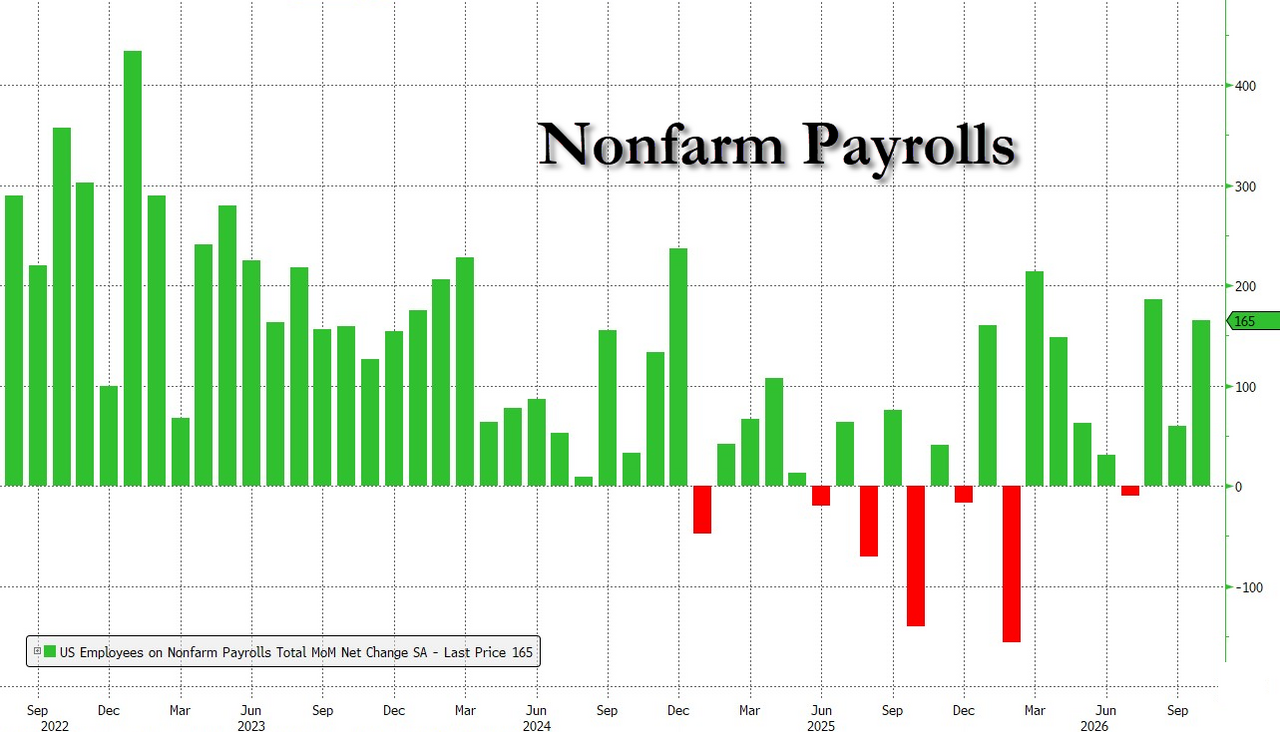
finance · Zero HedgeUS Jobs Soar By 165K Blowing Away Estimates; Unemployment Rate Drops Putting Dec Rate Hike Back In Play In our preview of the October jobs report , we said that the labor data has rarely looked this solid going into a monthly payrolls report: claims near 57-year lows, the lowest October layoffs since 2023, JOLTS openings up 333K and ADP above expectations. If anything, the risk is to the upside of the 63K consensus, and the unemployment rate could well tick down. Which, as we noted, was the problem as "a strong print gives Warsh, Hammack and Barkin all the cover they need to hike in December, right as the Nasdaq is coming off its worst day since March 2020. Goldman's rates desk thinks a single print can't take the hikes out." We said that we agree with this take, and added that the more likely outcome is a decent number that puts December back in play and adds a rates problem to what has so far been an AI problem. Given where positioning is, CTAs already selling and long-only "frozen (again)," that's not a recipe for a relief rally. Well, moments ago, the BLS reported the October jobs and it came extremely red hot, enough to indeed put a December rate hike back on the docket, AI collapse notwithstanding. Here are the numbers: October monthly payrolls rose by 165K, up more than double the 70K expected bounce, and the third highest print of 2026 (this was once again driven by private jobs, which surged by 159K , smashing expectations of 65K; government only accounted for 6K jobs in October). The number was so hot it not only printed above the highest Wall Street estimate... ... it was a 5-sigma beat to the median consensus number. Not only was October red hot, prior month revision were all higher: the August was revised up by 53,000, from +133,000 to +186,000, and September was revised up by 31,000, from +29,000 to +60,000. With these revisions, employment in August and September combined is 84,000 higher than previously reported. While the payrolls number was red hot, the monthly worker change blew it away, as 463K workers were added according to the Household survey, the third consecutive month of 400K+ workers added... ... which in turn helped the persistently lagging total worker series catch up every closer to the much stronger, in recent years, payrolls series. Just as remarkable is that after years of chronic underperformance by full-time jobs, in October the number of full-time jobs soared by 714K, the second highest monthly increase in 2026, while par-time jobs plunged by 242K. The one blemish in the report was that after a year of declining foreign-born workers, in October we saw 809K foreign-born workers added, the biggest increase since Jan 2025, while native-born workers dropped by 64K. It wasn't just the job numbers that came in red hot: the unemployment rate unexpectedly dipped back to 4.1% from 4.2%, and against expectations of an unchanged print. Among the major worker groups, the unemployment rates showed little or no change in October for adult men (3.9%), adult women (3.6%), teenagers (13.9%), and people who are White (3.7%), Black (6.6%), Asian (2.8 percent), or Hispanic (4.7 percent). Both the labor force participation rate, at 61.9%, and the employment-population ratio, at 59.3%, changed little in October. These measures have shown little net change since January. And completing the trifecta of hot data was the average hourly earnings which beat expectations both MoM and YoY, with the former printing 0.4%, above the 0.3% expected, and the highest since Nov 2025, while the annual change in earnings disappointed expectations of the first sub-3% print since covid, and instead rose from the pre-revision 3.0% to 3.1% (then again Sept was revised higher to 3.2%). The average workweek for all employees on private nonfarm payrolls remained at 34.4 hours in October. In manufacturing, the average workweek was unchanged at 40.5 hours, and overtime edged up by 0.1 hour to 3.1 hours
ORIGINAL REPORTING ↗